
15
Wrath of the Hills
“This story is dedicated to all who lost their lives, homes, and lands in the Coorg landslides of 2018—may their courage and spirit forever guide us to live in harmony with nature.”
The Kakkada Rains
It was the month of Kakkada, when the monsoon clouds poured endlessly over the hills of Coorg. The rivers, once gentle, roared with fury. A sudden cloudburst shook the valley—streams overflowed, roads cracked apart, and a giant hillside slid down like a wounded beast. Mud and boulders swallowed the path to a neighboring village. Houses collapsed, and frightened voices cried for help in the stormy night.
The once green slopes now looked like scars across the valley. Coffee plants lay uprooted, and the fragrance of wet blossoms mixed with the acrid smell of broken earth. Lightning flashed, illuminating fallen trees that lay like wounded soldiers across the ground.
Bopu stood at his window, heart pounding, watching the swollen river. Bollu barked nervously, pacing in circles, sensing the danger that loomed all around. The land he loved was hurting, and he knew something had to be done.
In the distance, thunder rolled like a war drum. The scent of wet earth filled the air, heavy with sorrow. Bopu clenched his fists and whispered, “We cannot let our neighbors suffer alone.” He thought of the old stories his grandfather told—about the gods of the hills protecting those who stood with courage. Tonight, those stories felt alive.
The Call to Rescue
The next morning, Bopu’s okka (clan family) and the villagers gathered at the Ainmane courtyard. The air was heavy with worry. Elder Muthanna declared, “We must send a rescue team before it’s too late.”
Bopu’s hand shot up. “I will come!” Kaveri, standing beside him, nodded firmly. “Me too.” Bollu wagged his tail, already ready for action.
Bopu joined the men in gathering tools—spades, ropes, lanterns and all that is required for digging through the earth. Bollu sniffed around the piles of equipment, as if checking everything himself. Kaveri went with the women, helping to prepare food packets, rolling blankets, and collecting warm clothes for the stranded families.
As ropes were being sorted, Bopu noticed a few men struggling to make them secure. “Uncle, let me show you,” he said eagerly. Using what he had learned in the Scouts, he tied a strong clove hitch around a wooden beam. Kaveri followed, showing the women how to make quick reef knots to bundle blankets tightly. The elders watched with admiration.
“See? Even the children bring wisdom,” Elder Muthanna said proudly. “Knowledge is strength when shared.”
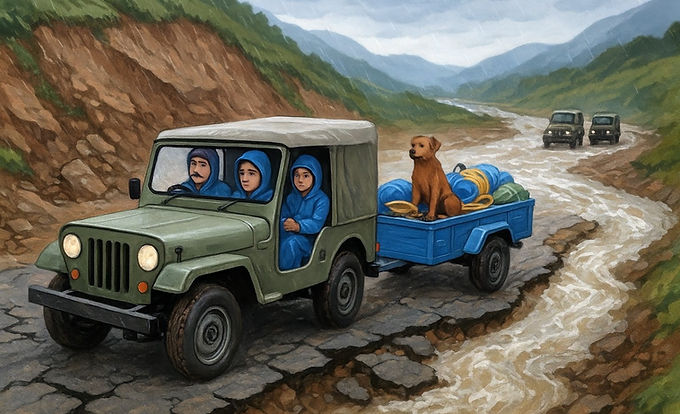
Uncle Pattu’s old green jeep rumbled to life. Its trailer was packed with tools, food, and basic supplies. Mothers hugged their children before sending them on the dangerous road, whispering prayers for their safety.
Bopu’s heart swelled with determination—he felt like a soldier about to defend his homeland.
The Trail of Courage
The rescue team set out, their jeeps crawling carefully along damaged roads. The monsoon rains hadn’t stopped, and each bend in the trail brought new dangers—slippery mud, falling stones, and the roaring sound of the river that had overflowed its banks.
At one broken crossing, the team stopped. The bridge was washed away, and the river raged furiously, separating them from the stranded village. The men debated building a ropeway, tying knots carefully as Bopu and Kaveri had taught them earlier. Everyone worked together, but the current was so strong that no one dared to swim across.
Just then, Bollu seized the rope in his jaws. Without waiting for Bopu’s call, he leapt fearlessly into the raging waters. Bopu cried out, “Bollu, no!” but it was too late. The brave dog paddled against the strong currents, the rope clenched tightly, his brown fur soaked by the rain.
He reached the other side, where anxious villagers cheered and quickly tied the rope to a strong tree. The bridge of hope was built—not by the strongest men, but by the loyalty and courage of a playful dog who loved his people.
Kaveri whispered softly, “Even the smallest heart can carry the greatest courage.” Bopu smiled with pride and relief, “Bollu, you are the true hero of today.”
Further ahead, a large tree lay across the path, its roots jutting out like giant claws. With axes and teamwork, they hacked and pushed until the way was cleared. Sweat mixed with rainwater, and though their bodies ached, no one dared give up.
Along the trail, Kaveri handed food to tired rescuers, keeping their spirits alive with her calm voice. “Eat a little, drink some water—we must keep our strength.” Her words felt like sunlight piercing through the storm.
The hills seemed to test their will with every step, but slowly, steadily, they pressed on. By evening, soaked to the bone, they pushed through the last stretch of slush and rock. The ruined village lay ahead—silent except for the cries of those trapped. Children clung to rooftops, and cows moaned weakly in flooded sheds. The team knew the real battle was only just beginning.
“Every broken path can be crossed with courage, patience, and the strength of many hands working as one.”
Hands That Heal, Hearts That Save
The team rushed into action. Bopu and the men dug tirelessly, their spades striking through mud to pull out survivors. Every scoop of soil felt like a battle against time. Sweat stung his eyes, but he pushed harder, knowing that a life could be saved with every strike.
Bollu’s sharp nose found a calf buried under straw and mud. He barked frantically, paws scraping at the soil until Bopu and the elders rushed to help. Together they pulled the trembling animal out alive, and the villagers cheered through their exhaustion. Bollu wagged his tail proudly, his fur coated in mud, a true rescuer in spirit.
Kaveri tended to the injured with soft hands, tying cloth around wounds, feeding the weak with warm food packets. She comforted a little girl who had lost her home, whispering gentle prayers that steadied frightened hearts. An old grandmother, shivering from the cold, clutched Kaveri’s hand and whispered, “You are like my own granddaughter. May the gods bless you.”
A villager groaned in pain, trapped under a fallen beam. With ropes and teamwork, Bopu and the elders lifted it away. The man’s first words were a blessing: “May your courage grow with the mountains, child.”
As night fell, lanterns flickered in the ruined streets. The team gathered the rescued families and began the trek back. Along the way, children clung to their mothers, cows were guided carefully, and elders leaned on strong shoulders.
In the safer village, they raised temporary shelters of bamboo and tarpaulin. The smell of hot rice and curry filled the air, warming tired bodies. For the first time since the disaster, hope returned. Bopu sat by the fire, exhausted but proud, as Bollu curled beside him. Kaveri smiled faintly across the flames, both of them knowing they had done something that mattered deeply.
The Call of the Elders
As the rain slowed, the truth behind the destruction became clear. Carriappa Ajja, the naad thakka spoke in hushed tones: trees had been cut illegally in the sacred devara kaad, and hillsides had been stripped bare for greedy farming. Without roots to hold the soil, the mountain had collapsed, dragging lives and homes into chaos.
That evening, in the gathering of villagers, Elder Muthanna raised his voice. “This disaster is not only from the rain—it is from our own careless hands. The forest spirits are not pleased. We must not betray the guardians of our land.”
All eyes turned to Chengappa, a resident of the affected village, whose ancestral land and devara kaad behind it, had been secretly opened to the timber mafia. The thakka’s words cut deep: “Chengappa, you allowed greed to blind you. Large trees were cut down and timber was stolen under your watch. Look around - your own people now suffer. This must end today.”
Chengappa lowered his head in shame, unable to meet the eyes of his community. His hands trembled, and guilt weighed on his shoulders heavier than any mudslide. Some villagers shook their heads in disappointment, while others placed firm hands on his back—urging him to repent and choose the path of honor.
Bopu looked at the scarred valley with sorrow. “Nature warned us, but we did not listen,” he said quietly. Kaveri added firmly, “We must live in harmony, not against the forest.”
The elders passed a resolution that no tree would fall illegally again, no sacred grove would be touched, and anyone aiding destruction would be held accountable. Villagers pledged to replant trees and guard the deva kaad. Children were taught songs and stories of the forest, so they would grow up to protect it with love instead of greed.
A solemn prayer rose in the firelit night, voices carrying across the valley: a promise to the rivers, hills, and trees that they would be protectors, not destroyers. The rain had tested them, but it had also awakened them.
“To harm the forest is to harm ourselves. Protect the hills, and the hills will protect us. Respect the rivers, and they will feed our children. Greed must never silence the wisdom of the earth.”
That night, under the flickering firelight, Bopu, Kaveri, and Bollu lay awake, listening to the soft rustle of the trees. They knew this was not just a rescue mission—it was the beginning of a greater journey: to guard the land of Coorg, to awaken its people, and to carry forward the voice of nature.